
AutoPlay is a feature of Windows that lets you indicate what you want your system to do (if anything) whenever certain types of media are inserted into your computer. To configure your AutoPlay settings, display the Control Panel, click the Hardware and Sound link, and then click the AutoPlay link. Windows displays the AutoPlay dialog box. (See Figure 1.)
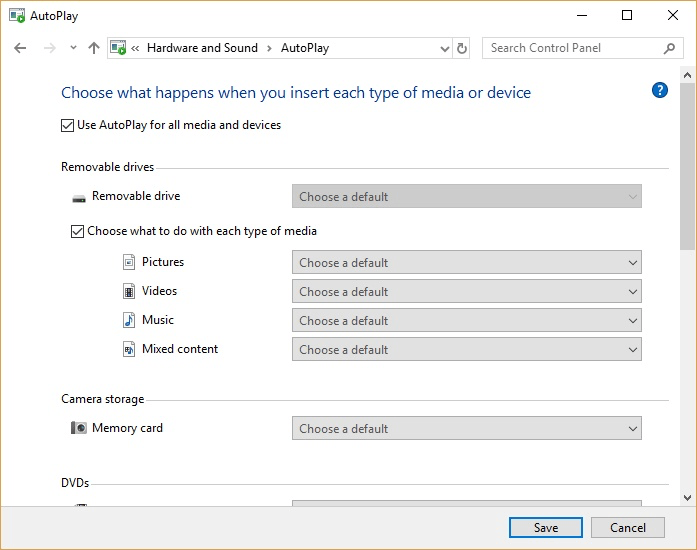
Figure 1. The AutoPlay dialog box.
It is the AutoPlay dialog box where you indicate the behavior your system should perform when it detects the presence of the various listed media. For example, if I insert an audio CD into my machine, it automatically starts playing it with Windows Media Player. However, if I insert a CD that contains pictures, the system asks me what to do.
You tell your system what to do by pulling down the drop-down list beside each type of media and selecting a default behavior. For example, if I want to open a folder in Windows Explorer (Windows 7) or File Explorer (Windows 8 and Windows 10) every time a picture CD is inserted, I would pull down the drop-down list beside the Pictures item and select the behavior.
To turn off AutoPlay altogether, clear the checkbox near the top of the AutoPlay dialog box. When you are done making the desired changes, click the Save button.


 This tip (10111) applies to Windows 7, 8, and 10.
When browsing through your system, you might see several files named Desktop.ini. This tip explains what these files are ...
Discover MoreWindows will load apps at startup, which can impact performance. Quickly deactivate startup items that can affect the ...
Discover MoreReadyBoost promised to provide a hot-swappable addition of memory that could end up improving system performance. Whether ...
Discover MoreThere are currently no comments for this tip. (Be the first to leave your comment—just use the simple form above!)
Copyright © 2026 Sharon Parq Associates, Inc.

Comments